
El Chaltén floraan atlas of plants, trees and mountain flowers
The valley holds steppe, forest, stone and ice within ten kilometres, each with its own plants. This map has the 211 species recorded around town, each at the place, altitude and month someone saw it.
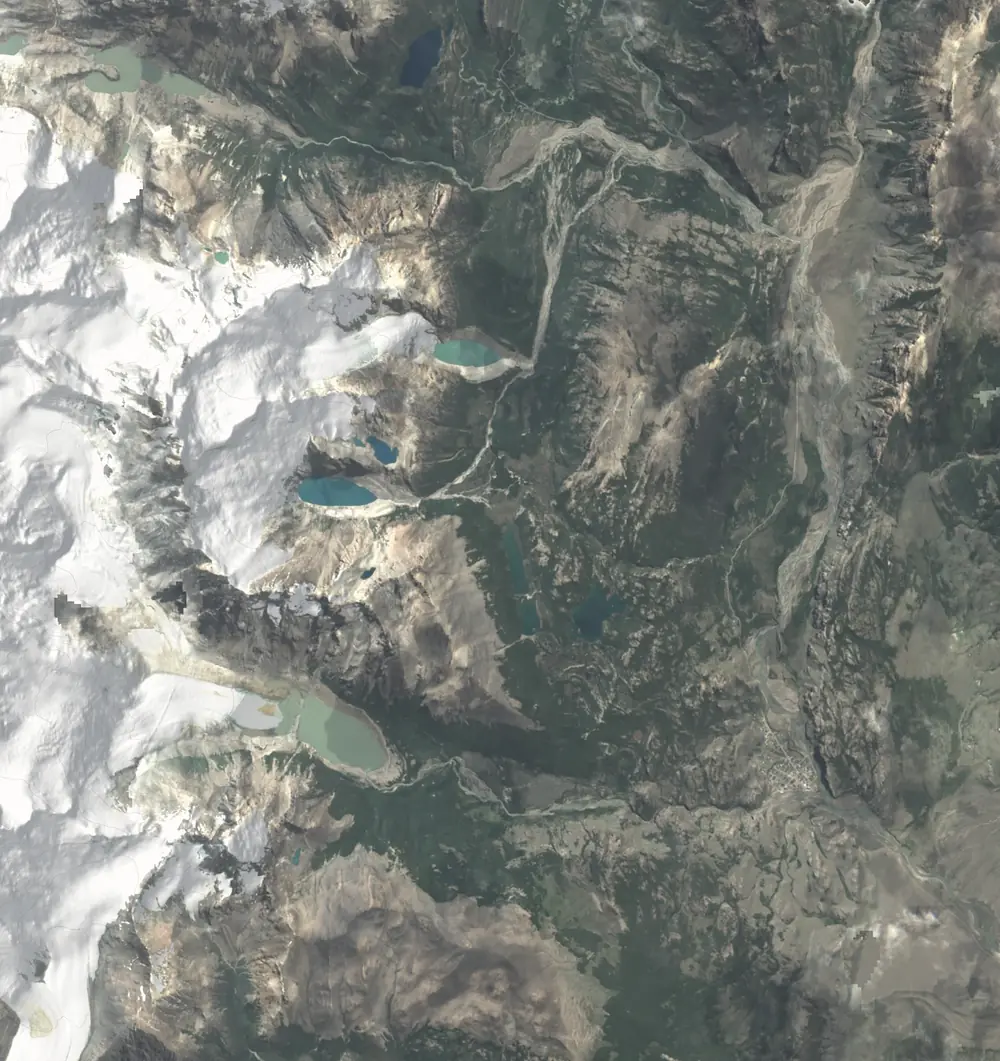
Habitats
record in flower
Relief: Copernicus GLO-30 and Sentinel-2 cloudless (EOX). Habitats: ESA WorldCover 2021. Records: iNaturalist, research grade, up to 16 November 2026. Ctrl or cmd and the wheel, or two fingers, zoom in.
The mountain in floors
Town sits at 401 metres, right where the forest ends and the steppe begins. Going up, lenga forest covers more than half the ground up to 900 metres and ends near 1,100. Higher up there is stone, cushion plants and, from 1,600 metres, more ice than rock. On the left, what the land is like in each 100-metre band; on the right, between which altitudes each plant was recorded.
Plants do not all climb the same. Steppe plants such as the neneo and the mata guanaco stay near town, in the sun and wind. Shade plants such as the palomita live inside the forest. A few go the whole way: the crowberry and Darwin’s slipper start low and carry on past the last tree.
Above the forest everything grows low and tight. Cushions keep warmth in, break the wind and hold moisture; that is why Azorella, Nassauvia and the high Oxalis look the way they do. The highest climber is Pygmy nassauvia: one record in twenty is above 1,506 metres.
When each one flowers
Spring arrives in October on the steppe by town and climbs with the melting snow. This table uses only the records their observers tagged “flowering”: a full dot is the month with most flowers for that plant. From April to September there are almost no flowers or records.
| Plant | Altitude | Oct | Nov | Dec | Jan | Feb | Mar |
|---|---|---|---|---|---|---|---|
| Mata guanacoAnarthrophyllum desideratum | 456–533 m | ||||||
| AnemoneAnemone multifida | 456–619 m | ||||||
| NeneoAzorella prolifera | 407–562 m | ||||||
| QuinchamalíQuinchamalium chilense | 427–558 m | ||||||
| ParamelaAdesmia boronioides | 432–500 m | ||||||
| Palomita orchidCodonorchis lessonii | 531–735 m | ||||||
| Topa topaCalceolaria biflora | 519–730 m | ||||||
| Magellan saxifrageSaxifraga magellanica | 496–704 m | ||||||
| Waterfall flowerOurisia ruellioides | 592–788 m | ||||||
| HuilmoOlsynium junceum | 456–558 m | ||||||
| Alpine chloraeaChloraea alpina | 540–571 m | ||||||
| CampanitaOlsynium biflorum | 474–530 m | ||||||
| Chilean firebushEmbothrium coccineum | 513–714 m | ||||||
| Darwin’s slipperCalceolaria uniflora | 553–1,128 m | ||||||
| Yellow orchidGavilea lutea | 533–738 m | ||||||
| Porcelain orchidChloraea magellanica | 446–540 m | ||||||
| SolenomelusSolenomelus segethi | 420–556 m | ||||||
| High oxalisOxalis loricata | 1,136–1,319 m | ||||||
| PereziaPerezia recurvata | 494–560 m | ||||||
| Calceolaria tenellaCalceolaria tenella | 465–744 m | ||||||
| Mata negraChiliotrichum diffusum | 593–753 m | ||||||
| EscalloniaEscallonia virgata | 472–604 m | ||||||
| PereziaPerezia linearis | 555–728 m |
The lenga and the ñire
The two trees you will see all day are southern beeches, genus Nothofagus, cousins of the northern oaks and beeches. They look alike, live together, and each has its place.
Lenga Nothofagus pumilio
El Chaltén’s tree: nearly all the forest you see is lenga. It drops its leaves in winter, and in April it turns yellow, orange and red. The leaf edge has small rounded lobes, two between each vein. The higher it grows, the lower it stays: near the treeline it is a knee-high mat combed by the wind. In our data, half the records lie between 510 and 738 metres, reaching 1,043.
Ñire Nothofagus antarctica
The lenga’s relative: smaller, more twisted, often with many trunks from the base. The leaf is smaller, irregularly toothed and wavy. It grows where the lenga struggles: in cold wet hollows, on the dry edge with the steppe and on stony hills. That is why it surrounds town and the trailheads. It resprouts from the base after a fire. In autumn it turns red too. It is recorded lower than the lenga: half the ñires are below 462 metres, against 602 for the lenga.
What lives on the tree
Look at the branches. The yellow-green tufts hanging there are feathery mistletoes, plants that live on the sap of lenga and ñire and release plumed seeds for the wind to carry. The orange balls, like golf balls with little holes, are a fungus, Cyttaria, that only grows on Nothofagus; the Tehuelche and other southern peoples ate it. And the grey threads hanging like a beard are a lichen, old man’s beard.
The herbarium
The most recorded plants, grouped by where you will find them. The numbers are our own: the altitude holding half the records, the months it is seen most and the habitat it shows up in.
Trees
Three southern beeches and a small red tree. Nearly all the forest you see from town is a single species.
- Lenga beechNothofagus pumilioNothofagaceae · 119 records
- Altitude
- 510–738 m
- Where
- forest 53 % · steppe and scrub 37 %
El Chaltén’s tree: nearly all the forest you see is lenga. It drops its leaves in winter, and in April it turns yellow, orange and red. The leaf edge has small rounded lobes, two between each vein. The higher it grows, the lower it stays: near the treeline it is a knee-high mat combed by the wind.
- Ñire (Antarctic beech)Nothofagus antarcticaNothofagaceae · 60 records
- Altitude
- 414–555 m
- Where
- forest 50 % · steppe and scrub 48 %
The lenga’s relative: smaller, more twisted, often with many trunks from the base. The leaf is smaller, irregularly toothed and wavy. It grows where the lenga struggles: in cold wet hollows, on the dry edge with the steppe and on stony hills. That is why it surrounds town and the trailheads. It resprouts from the base after a fire. In autumn it turns red too.
- Chilean firebushEmbothrium coccineumProteaceae · 107 records
- Altitude
- 513–714 m
- Flowers
- Dec
- Where
- steppe and scrub 39 % · forest 38 % · rock and moraine 24 %
The red you see from far away. A shrub or small tree with clusters of fire-red tubular flowers, sometimes so laden you can’t see the leaves. It flowers from November to January, peaking in December.
- Magellan’s beechNothofagus betuloidesNothofagaceae · 4 records
- Altitude
- 538–669 m
- Where
- forest 100 %
The third beech, the one that keeps its leaves: small, thick, glossy leaves all year. It likes the rain from the west; here it is scarce, in the wettest valleys and towards Lago del Desierto.
Shrubs
What grows at the forest edge and on the hills, where the wind won’t let a tree grow tall.
- CalafateBerberis microphyllaBerberidaceae · 81 records
- Altitude
- 417–551 m
- Where
- steppe and scrub 51 % · forest 36 % · rock and moraine 13 %
The spiny shrub that named El Calafate. In October and November it fills with tiny yellow flowers hanging like bells; in summer it bears a dark blue berry that town turns into jam and ice cream. They say whoever eats calafate comes back.
- Red crowberryEmpetrum rubrumEricaceae · 90 records
- Altitude
- 559–731 m
- Where
- rock and moraine 38 % · forest 34 % · steppe and scrub 28 %
A creeping mat of needle-like leaves that carpets stone and poor soil. It bears small red berries. One of the few plants that goes with you from town to above the forest.
- ParamelaAdesmia boronioidesFabaceae · 81 records
- Altitude
- 432–500 m
- Flowers
- Nov, Dec, Jan
- Where
- steppe and scrub 59 % · rock and moraine 28 % · forest 13 %
An aromatic, sticky shrub with yellow flowers. Rub a leaf and smell your fingers: sweet resin. It grows on dry, sunny hills.
- Prickly heathGaultheria mucronataEricaceae · 66 records
- Altitude
- 516–713 m
- Where
- forest 44 % · steppe and scrub 31 % · rock and moraine 26 %
A shrub with small, hard, pointed leaves, white bell flowers and berries that go from white to pink and red in late summer.
- Mata guanacoAnarthrophyllum desideratumFabaceae · 52 records
- Altitude
- 456–533 m
- Flowers
- Oct, Nov, Dec
- Where
- steppe and scrub 58 % · rock and moraine 38 %
A low, spiny cushion shrub that in October and November is covered in orange and red pea flowers. A steppe plant: you will see it on the dry hills of the viewpoints, not in the forest.
- NeneoAzorella proliferaApiaceae · 95 records
- Altitude
- 407–562 m
- Flowers
- Nov, Dec, Jan
- Where
- steppe and scrub 70 % · forest 15 % · rock and moraine 15 %
The steppe’s bush: a green, spiny half-sphere, hard as a hedgehog, with small yellowish flowers in summer. It used to be called Mulinum spinosum.
- Mata negraChiliotrichum diffusumAsteraceae · 50 records
- Altitude
- 593–753 m
- Flowers
- Jan
- Where
- forest 65 % · steppe and scrub 24 % · rock and moraine 10 %
A shrub with narrow dark leaves and white flowers like small daisies. It flowers in December and January at forest edges.
- Crowberry-leaved barberryBerberis empetrifoliaBerberidaceae · 35 records
- Altitude
- 459–684 m
- Where
- steppe and scrub 47 % · rock and moraine 29 % · forest 24 %
- EscalloniaEscallonia virgataEscalloniaceae · 34 records
- Altitude
- 472–604 m
- Flowers
- Jan, Feb
- Where
- steppe and scrub 56 % · forest 41 %
- Magellan baccharisBaccharis magellanicaAsteraceae · 25 records
- Altitude
- 504–724 m
- Where
- steppe and scrub 67 % · rock and moraine 21 % · forest 13 %
- Red escalloniaEscallonia rubraEscalloniaceae · 12 records
- Altitude
- 526–714 m
- Where
- forest 55 % · steppe and scrub 36 %
- ChacayDiscaria chacayeRhamnaceae · 11 records
- Altitude
- 526–712 m
- Where
- forest 36 % · rock and moraine 36 % · steppe and scrub 27 %
- Magellan currantRibes magellanicumGrossulariaceae · 4 records
- Altitude
- 460–630 m
- Where
- forest 75 % · steppe and scrub 25 %
Orchids
Ground orchids, small and commoner than people think. You have to crouch.
- Palomita orchidCodonorchis lessoniiOrchidaceae · 68 records
- Altitude
- 531–735 m
- Flowers
- Nov, Dec
- Where
- forest 94 %
A single white flower on a stem with two or three leaves in a ring. It lives in the shade of the lenga forest: in our records, nearly all are inside the forest.
- Yellow orchidGavilea luteaOrchidaceae · 50 records
- Altitude
- 533–738 m
- Flowers
- Dec, Jan
- Where
- forest 90 % · steppe and scrub 10 %
Several yellow flowers on a spike. Forest clearings, December and January.
- Porcelain orchidChloraea magellanicaOrchidaceae · 46 records
- Altitude
- 446–540 m
- Flowers
- Dec, Jan
- Where
- steppe and scrub 57 % · forest 39 %
The showiest: white flowers with a net of green veins, like painted porcelain. Grassland and clearings near town.
- Alpine chloraeaChloraea alpinaOrchidaceae · 29 records
- Altitude
- 540–571 m
- Flowers
- Nov
- Where
- steppe and scrub 72 % · rock and moraine 24 %
Greenish-yellow veined flowers. One of the earliest, in November, on the open slopes of the Laguna Torre trail.
Forest flowers
In the shade of the lengas and beside the water.
- Topa topaCalceolaria bifloraCalceolariaceae · 67 records
- Altitude
- 519–730 m
- Flowers
- Nov, Dec, Jan
- Where
- forest 48 % · steppe and scrub 39 % · rock and moraine 13 %
The slipper’s cousin: two or more yellow pouches on a long stem, with the leaves in a rosette. In grassland and clearings on every trail.
- Waterfall flowerOurisia ruellioidesPlantaginaceae · 41 records
- Altitude
- 592–788 m
- Flowers
- Nov, Dec, Jan
- Where
- forest 49 % · rock and moraine 33 % · steppe and scrub 18 %
Red tubular flowers on wet rock, beside waterfalls and streams.
- Devil’s strawberryGunnera magellanicaGunneraceae · 32 records
- Altitude
- 482–701 m
- Where
- forest 57 % · steppe and scrub 29 % · rock and moraine 14 %
Round leaves carpeting wet ground by the water, and small red fruits you don’t eat.
- PhaceliaPhacelia secundaBoraginaceae · 22 records
- Altitude
- 438–583 m
- Where
- forest 55 % · steppe and scrub 27 % · rock and moraine 18 %
- Feathery mistletoeMisodendrum linearifoliumMisodendraceae · 31 records
- Altitude
- 489–725 m
- Where
- forest 59 % · steppe and scrub 31 % · rock and moraine 10 %
The yellow-green tufts hanging from lenga and ñire branches: a plant that lives on the tree’s sap. Its seeds carry long feathery bristles and the wind takes them to the next branch.
- AcaenaAcaena ovalifoliaRosaceae · 16 records
- Altitude
- 480–737 m
- Where
- forest 88 %
- Alpine water fernBlechnum penna-marinaBlechnaceae · 15 records
- Altitude
- 477–653 m
- Where
- forest 67 % · steppe and scrub 27 %
- ArachnitisArachnitis unifloraCorsiaceae · 9 records
- Altitude
- 686–767 m
- Where
- forest 100 %
An oddity: it has no green leaves and does no photosynthesis. It lives off fungi in the forest soil and only shows one translucent, glass-like flower.
- LuzuriagaLuzuriaga marginataAlstroemeriaceae · 7 records
- Altitude
- 523–623 m
- Where
- forest 100 %
- VioletViola reicheiViolaceae · 7 records
- Altitude
- 476–847 m
- Where
- forest 86 % · rock and moraine 14 %
Flowers of the steppe and the hills
In the sun, on dry stony ground. They flower first, from October.
- AnemoneAnemone multifidaRanunculaceae · 119 records
- Altitude
- 456–619 m
- Flowers
- Nov, Dec, Jan
- Where
- steppe and scrub 54 % · forest 32 % · rock and moraine 14 %
El Chaltén’s most recorded flower. Creamy white petals, sometimes yellowish or pink outside, and finely cut leaves. November and December.
- QuinchamalíQuinchamalium chilenseSchoepfiaceae · 84 records
- Altitude
- 427–558 m
- Flowers
- Nov, Dec, Jan
- Where
- steppe and scrub 73 % · rock and moraine 19 %
A small plant with clusters of yellow-orange tubular flowers. It hooks onto the roots of its neighbours and takes some of their water. Very common on sunny hills.
- Darwin’s slipperCalceolaria unifloraCalceolariaceae · 56 records
- Altitude
- 553–1,128 m
- Flowers
- Dec, Jan, Feb
- Where
- rock and moraine 46 % · steppe and scrub 43 % · forest 11 %
The flower that gets the most photos: an orange and yellow slipper two or three centimetres long, with a white band in front. Darwin collected it in Patagonia. Birds eat the white part and pollinate it as they do. It grows flat on loose stone, and climbs high: there are records above 1,400 m.
- Fleshy valerianValeriana carnosaCaprifoliaceae · 54 records
- Altitude
- 466–611 m
- Where
- steppe and scrub 51 % · forest 32 % · rock and moraine 17 %
- HuilmoOlsynium junceumIridaceae · 29 records
- Altitude
- 456–558 m
- Flowers
- Nov
- Where
- steppe and scrub 76 % · forest 14 % · rock and moraine 10 %
A small relative of the iris, with lilac or white flowers, on the steppe near town. October and November.
- SolenomelusSolenomelus segethiIridaceae · 28 records
- Altitude
- 420–556 m
- Flowers
- Dec, Jan
- Where
- steppe and scrub 73 % · forest 15 % · rock and moraine 12 %
- Sea pinkArmeria curvifoliaPlumbaginaceae · 36 records
- Altitude
- 504–865 m
- Where
- rock and moraine 59 % · steppe and scrub 34 %
Pink pompoms on thin stems, in dry stony places.
- CampanitaOlsynium biflorumIridaceae · 19 records
- Altitude
- 474–530 m
- Flowers
- Nov, Dec
- Where
- steppe and scrub 61 % · forest 28 % · rock and moraine 11 %
White veined bells, in pairs. November and December.
- Magellan saxifrageSaxifraga magellanicaSaxifragaceae · 55 records
- Altitude
- 496–704 m
- Flowers
- Nov, Dec
- Where
- steppe and scrub 50 % · forest 24 % · rock and moraine 24 %
- PereziaPerezia recurvataAsteraceae · 13 records
- Altitude
- 494–560 m
- Flowers
- Dec, Jan, Feb
- Where
- forest 33 % · steppe and scrub 33 % · rock and moraine 33 %
- Magellan avensGeum magellanicumRosaceae · 17 records
- Altitude
- 446–652 m
- Where
- forest 75 % · steppe and scrub 25 %
Above the treeline
Above 1,100 metres: cushions, rosettes pressed to the stone and flowers that open as soon as the snow goes.
- High oxalisOxalis loricataOxalidaceae · 18 records
- Altitude
- 1,136–1,319 m
- Flowers
- Dec
- Where
- rock and moraine 100 %
One of the highest-recorded plants in El Chaltén: on loose stone, between 1,000 and 1,500 m.
- Cushion azorellaAzorella monanthaApiaceae · 45 records
- Altitude
- 429–734 m
- Where
- rock and moraine 50 % · steppe and scrub 40 % · forest 10 %
A hard, tight, dark green cushion with tiny yellow flowers. The cushion shape holds warmth and stands up to wind: that is why nearly everything up high grows this way.
- NassauviaNassauvia magellanicaAsteraceae · 13 records
- Altitude
- 1,143–1,191 m
- Where
- rock and moraine 83 %
- Pygmy nassauviaNassauvia pygmaeaAsteraceae · 10 records
- Altitude
- 1,174–1,497 m
- Where
- rock and moraine 100 %
- Marsh marigoldCaltha sagittataRanunculaceae · 12 records
- Altitude
- 945–1,113 m
- Where
- steppe and scrub 58 % · rock and moraine 25 % · forest 17 %
Yellow flowers in places soaked by melting snow, above the forest.
- MenonvilleaMenonvillea nordenskjoeldiiBrassicaceae · 11 records
- Altitude
- 906–1,223 m
- Where
- rock and moraine 70 % · steppe and scrub 10 %
- OreopolusOreopolus glacialisRubiaceae · 10 records
- Altitude
- 1,105–1,178 m
- Where
- rock and moraine 80 % · steppe and scrub 20 %
- LeucheriaLeucheria leontopodioidesAsteraceae · 8 records
- Altitude
- 1,241–1,355 m
- Where
- rock and moraine 100 %
- Scurvy grassOxalis enneaphyllaOxalidaceae · 6 records
- Altitude
- 1,067–1,101 m
- Where
- steppe and scrub 67 % · rock and moraine 33 %
- Magellan primrosePrimula magellanicaPrimulaceae · 4 records
- Altitude
- 896–1,021 m
- Where
- steppe and scrub 100 %
The ones that came from elsewhere
26 of the recorded species are not from here: they came with the road, the horses, grass seed and gardens. They add up to 192 records, nearly all in town and on the first stretch of the trails.
- Garden lupinLupinus polyphyllusFabaceae · 7 records
- Altitude
- 401–469 m
The purple and pink lupins that fill roadsides and town edges in summer. They come from North America and escaped from gardens: pretty and invasive.
- Sweet briarRosa rubiginosaRosaceae · 10 records
- Altitude
- 261–412 m
It comes from Europe. Its hips make rosehip jam; it is also spreading over the steppe.
And also: Field chickweed (Cerastium arvense), Yarrow (Achillea millefolium), White clover (Trifolium repens), Sheep’s sorrel (Rumex acetosella), Dandelion (Taraxacum officinale), Catsear (Hypochaeris radicata), Ribwort plantain (Plantago lanceolata), Eyebright (Euphrasia officinalis), Redstem Stork's-bill (Erodium cicutarium), Foxglove (Digitalis purpurea), Scotch broom (Cytisus scoparius), Red Clover (Trifolium pratense).
Which plants you will see on each trail
The plants recorded within 150 metres of our tracks, most seen first. The guides know on which bend the palomitas flower and where each patch of slippers grows, and they stop.
- Laguna de los Tres410–1,190 m · 84 species · from USD 228
The whole forest in one walk: lengas, notros along the edges, palomitas and yellow orchids in the shade, and above the moraine, the stone.
Chilean firebush · Lenga beech · Anemone · Yellow orchid · Red crowberry · Palomita orchid · Topa topa · Neneo · Prickly heath
- Laguna Torre421–641 m · 60 species · from USD 203
The open slopes at the start are the best place for the alpine chloraea, anemones and quinchamalí; then forest to the lake.
Alpine chloraea · Anemone · Red crowberry · Quinchamalí · Prickly heath · Lenga beech · Topa topa · Porcelain orchid · Escallonia
- Loma del Pliegue Tumbado452–1,507 m · 68 species · from USD 225
The trail that crosses the most floors in a day: steppe, forest, the treeline and the stone up top, with Darwin’s slipper and the cushion plants.
Darwin’s slipper · High oxalis · Anemone · Alpine chloraea · Calafate · Paramela · Quinchamalí · Oreopolus · Leucheria
- Mirador de las Águilas396–545 m · 38 species · from USD 100
Short and low, all on the steppe: neneo, mata guanaco, paramela and calafate. In October it is the first to flower.
Neneo · Mata guanaco · Quinchamalí · Paramela · Calafate · Anemone · Huilmo · Yarrow · Escallonia
- Lago del Desierto and Huemul Glacier510–740 m · 23 species
Wetter forest, with the biggest notros, palomitas and chaura.
Chilean firebush · Palomita orchid · Prickly heath · Red crowberry · Ñire (Antarctic beech) · Crowberry-leaved barberry · Calafate · Anemone · Lenga beech
- Piedras Blancas Glacier449–675 m · 23 species · from USD 180
Closed forest and clearings: the place for the shade orchids.
Paramela · Palomita orchid · Yellow orchid · Chilean firebush · Field chickweed · Porcelain orchid · Topa topa · Phacelia · Devil’s strawberry
- Loma de las Pizarras502–1,670 m · 48 species · from USD 265
It climbs to the stone above 1,600 m: from the valley orchids to the high flora.
Quinchamalí · Alpine chloraea · Chilean firebush · Anemone · Porcelain orchid · Magellan baccharis · Topa topa · Lenga beech · Neneo
- Eléctrico Valley and Piedra del Fraile448–543 m · 30 species · from USD 250
The Río Eléctrico valley, damp and shaded: devil’s strawberry, paramela and ferns.
Paramela · Devil’s strawberry · Lenga beech · Red crowberry · Phacelia · Garden lupin · Magellan saxifrage · Field chickweed · Crowberry-leaved barberry
Look, take nothing
Nearly all these trails are inside Los Glaciares National Park, where you may not take any plant, flower or seed. Beyond the law, these plants grow little and slowly: a high cushion can be decades old, a slipper pulled up does not come back, and the orchids depend on soil fungi that do not survive in a pot.
Photograph from the trail, and if the flower is far, zoom in: one step off the path flattens ten others you didn’t see. If you want to add what you find, upload it to iNaturalist with its location: every record ends up in maps like this one.
Spring wildflowers, month by month and where to photograph them → · Autumn, when the lenga turns red →
Questions about El Chaltén’s flora
What trees grow in El Chaltén?
Three southern beeches: the lenga, which makes up nearly all the forest; the ñire, smaller and twisted, in wet hollows and on the steppe edge; and the guindo, which keeps its leaves and is scarce, in the wettest valleys. Plus the notro, a small red-flowered tree. The forest reaches about 1,100 metres.
What is the difference between lenga and ñire?
The lenga is taller and makes the forest; its leaf edge has small rounded lobes, two between each vein. The ñire is smaller, twisted, often with several trunks, and its leaf is smaller, toothed and wavy. The ñire grows lower and where the lenga struggles: cold wet hollows and the dry edge of the steppe. Both drop their leaves and turn red in autumn.
How high does the forest reach in El Chaltén?
By ESA land cover, the forest covers more than half the ground up to 900 m and disappears near 1,100 m. Above that there is stone, cushion plants and, from 1,600 m, more ice than rock. Laguna de los Tres, at 1,162 m, is already above the forest.
When does El Chaltén flower?
From October to January. October is the month of calafate, mata guanaco and huilmo on the steppe; November, of anemones, palomitas and the alpine chloraea; December has the most flowers, with the notro at its best; in January Darwin’s slipper, the forest orchids and the high flowers carry on, opening as the snow goes.
Are there orchids in El Chaltén?
Yes, four common ones, all ground orchids: the palomita, the yellow orchid, the porcelain orchid and the alpine chloraea. They flower from November to January. The first two live in the forest shade; the other two in grassland and on open slopes.
What grows above the treeline?
Cushion and rosette plants pressed against the stone: Azorella, Nassauvia, a high Oxalis, Oreopolus, marsh marigold where the snow melts, and Darwin’s slipper, which climbs past 1,400 m. You see them on top of Pliegue Tumbado, on Loma de las Pizarras and on the Laguna de los Tres moraine.
Can I pick flowers, seeds or calafate berries?
Inside Los Glaciares National Park you may not take any plant, flower or seed. Look, photograph from the trail and leave it there. The calafate to eat is in town: jam, ice cream and beer.
Where does the map’s data come from?
Each dot is a community-confirmed (research grade) iNaturalist record between Lago del Desierto and Loma del Pliegue Tumbado: 2,611 records of 211 species, with altitude from the Copernicus GLO-30 terrain model. The habitats are ESA’s WorldCover 2021 land-cover map, at 10 metres. The records follow people: there are more near the trails and in summer.
Sources: iNaturalist (research-grade plant records, with each observer’s photos and identification), Copernicus DEM GLO-30, ESA WorldCover 2021 v200 (CC BY 4.0), EOX Sentinel-2 cloudless (CC BY 4.0; contains modified Copernicus Sentinel data). Our own calculations.