
Most people know El Chaltén in summer: a full town, sixteen hours of daylight and a queue on the moraine up to Laguna de los Tres. In winter it is a different place. Many shops close, few people walk the streets and the sun comes up at around ten in the morning. Fitz Roy and Cerro Torre are where they always were, but white from top to bottom, and the lenga forest goes silent.
We live here all year round, and have been part of the town since 1995. Snowshoe outings are on request: you write to us, we look at the snow for those days and plan the walk with a guide.
What snowshoeing is
A snowshoe is a wide platform strapped to your boot. It spreads your weight over a bigger area, so in soft, deep snow you sink a few centimetres instead of up to your knees. Modern ones are light, with metal teeth underneath to grip on climbs and a heel bar that flips up so slopes tire you less. You walk almost normally, feet a little wider apart, with poles.
It is not the same as crampons. Crampons are for ice and hard snow: a packed, frozen trail, a glassy descent first thing in the morning. Snowshoes are for fresh, loose snow. One day can bring both, which is why the guide decides what to carry by looking at the snow that morning.
Where you can walk in winter
The National Park does not close in winter, but snow changes the trails. What is an easy walk in January can take twice as long in July, and some stretches close on some days because of snow or ice. People walk these places in winter, but they are not a fixed menu: the guide picks the route by that day’s snow and avalanche risk.
| Place | From town | In winter |
|---|---|---|
| Chorrillo del Salto | 3 km one way, almost flat | Forest and a waterfall. The Park warns that in winter this easy trail becomes demanding. |
| Los Cóndores and Las Águilas viewpoints | 1 km and 2 km one way, next to the bus terminal | The snowy town below and Lago Viedma ahead. Good for short days. |
| The forest towards Laguna Capri and Mirador Fitz Roy | 4 km one way and 350 m of climbing | Lenga trees under snow and Fitz Roy straight ahead if it clears. |
| The Laguna Torre valley | 10 km one way and 250 m of climbing | A long, open valley with Cerro Torre at the end. How far you get depends on the snow. |
| The road to Lago del Desierto | 37 km north on route 41 | Valley forest, when the road is passable. |
One-way distances from the National Park trail leaflet, for summer. With snow they take longer.

This is what those routes are like in summer, with the map. In winter it is a different walk.
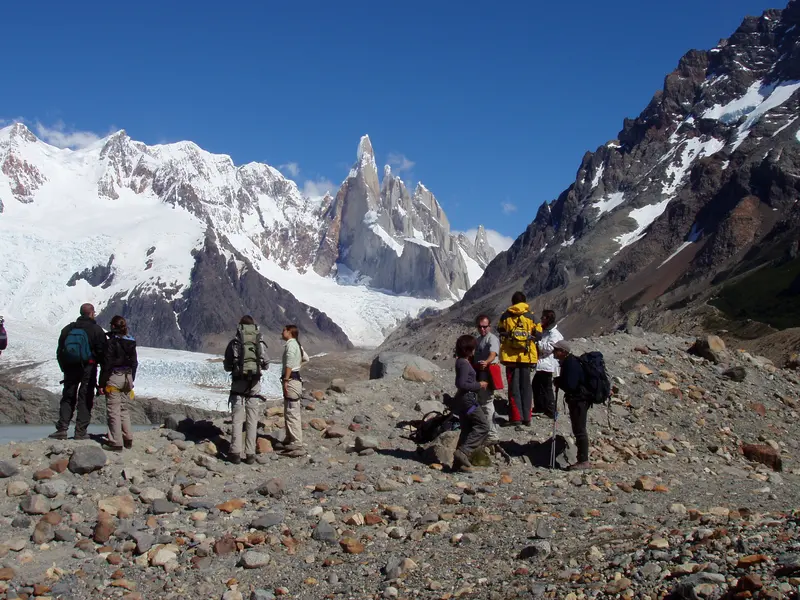 Laguna Torre16.6 km · +500 m · 7 to 8 h · from USD 203
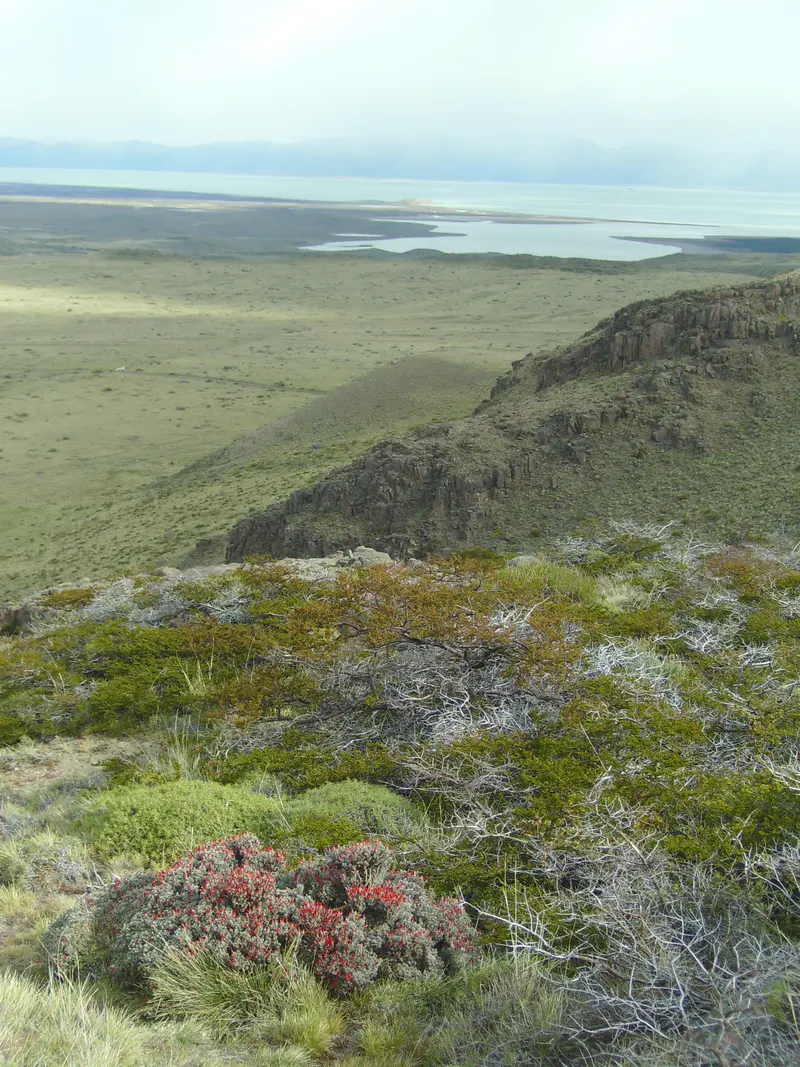 Mirador de las Águilas6.2 km · +150 m · 2 to 3 h · from USD 100
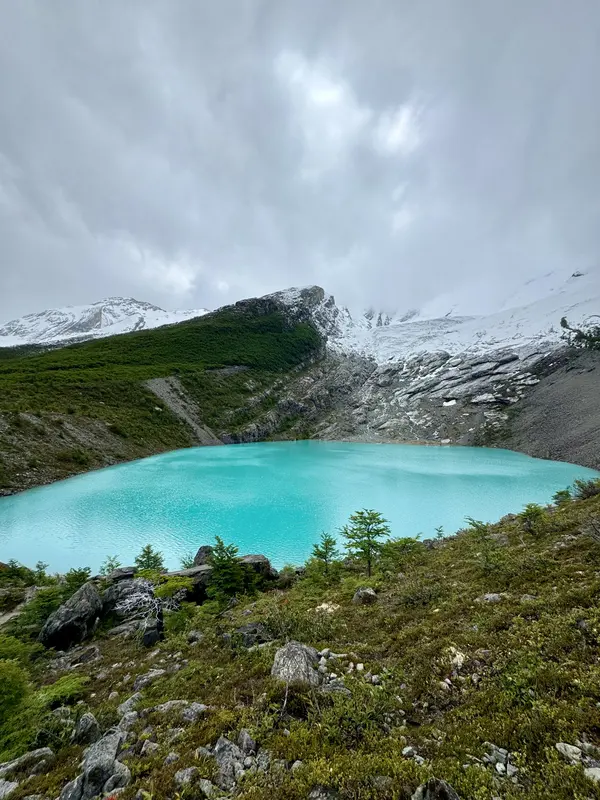 Lago del Desierto and Huemul Glacier3.4 km · +230 m · 6 to 8 h
What you don’t do in winter
- Walking on frozen lakes
- The Park forbids it. Lake ice is uneven, and falling into the water at these temperatures means hypothermia within minutes.
- The last climb to Laguna de los Tres
- It is a steep moraine of loose rock. With snow and ice it becomes mountaineering ground, not snowshoe ground.
- Walking under loaded slopes
- Snow on steep slopes can slide. Snowshoe outings keep to forest, valley floors and gentle ridges, away from gullies and from slopes with snow piled above the path.
- Going out without reading the day
- After heavy snowfall, or with wind loading the slopes, the guide may shorten or change the route. The outing still goes ahead; only very heavy snowfall moves it to the next day.
Cold, snow and light: the numbers
In town, July averages highs of 3 °C and lows of −3 °C. It freezes on about 22 nights out of 31. The coldest night of the last ten years in our data was −16.7 °C, in July 2026. Up in the forest and the valleys it is colder than in town, and when the wind blows you feel it far more.
In the town itself it doesn’t snow that often: in June and July there are about four days a month with a centimetre or more. The snow that makes snowshoeing worthwhile builds up higher, in the forest, where it doesn’t melt between one snowfall and the next. Every winter is different: some years bring plenty of snow in June, others only in August.
Light is what changes most. On 21 June the sun rises at 9:48 and sets at 17:58: just over eight hours. At noon it climbs only 17 degrees above the horizon, so the whole day has the low yellow light that in summer lasts a few minutes at dawn. By mid-August it rises at 9 and sets close to 19:00. And the wind eases: in May and June there are about four days a month with gusts over 60 km/h in town, against about ten from October to January. Read more →
| Month | High / low | Daylight | Very windy days |
|---|---|---|---|
| Jan | 15° / 7° | 15.7 h | 10 |
| Feb | 16° / 7° | 14.2 h | 8 |
| Mar | 13° / 6° | 12.4 h | 8 |
| Apr | 10° / 3° | 10.6 h | 6 |
| May | 7° / 0° | 9 h | 4 |
| Jun | 4° / -2° | 8.2 h | 4 |
| Jul | 3° / -3° | 8.6 h | 6 |
| Aug | 5° / -2° | 10 h | 7 |
| Sep | 7° / -1° | 11.8 h | 7 |
| Oct | 9° / 2° | 13.6 h | 10 |
| Nov | 12° / 4° | 15.3 h | 11 |
| Dec | 14° / 6° | 16.2 h | 10 |
Average 2016 to 2025 for the town (ERA5 reanalysis, Copernicus). Very windy: days with gusts over 60 km/h. Grey rows: the Park’s winter. Tap a month to see it day by day.
For photographers: with the sun rising so late, you see first light on Fitz Roy without an early alarm. You do need a clear day.

National Park rules in winter
- Crampons and poles
- They are compulsory on the Park’s trails from 1 May to 30 September, guided walkers included. The Park can extend the dates if snow or ice persists.
- Ask before you go
- Trail conditions are posted at the Guardaparque Ceferino Fonzo Visitor Centre, at the entrance to town. The Park asks you to tell someone before setting out and not to walk alone.
- Frozen lakes
- No walking or skating on them.
- All year round
- No fires, no pets, no drones, and your rubbish comes back with you. The Park entrance fee applies in winter too.
Entrance fee, hours and rules of Los Glaciares National Park. Read more →
What to wear
- Layers
- A thermal base layer that isn’t cotton, a fleece or wool mid-layer, a down or synthetic jacket for stops and a waterproof shell on top. On your legs, thermal leggings and waterproof trousers.
- Boots
- Waterproof walking boots with ankle support and thick wool socks. Snowshoes and crampons strap on over the boot. Gaiters keep the snow out.
- Hands and head
- Two pairs of gloves (a thin pair and a thick waterproof pair), a warm hat and a neck gaiter or buff.
- Eyes
- Sunglasses: snow reflects a lot of light, even with the sun low.
- In your pack
- A flask with something hot, food you can eat with gloves on, a head torch in case the afternoon runs short, and a bag for your rubbish.
If you don’t have snowshoes, crampons or poles, tell us when you write and we’ll tell you how to sort it out. Read more →
Getting here in winter
The nearest airport is El Calafate, which has flights from Buenos Aires in winter too. From there it is 213 km of paved road, about three hours by bus, and buses to El Chaltén run every day of the year. Between June and August snow or ice can slow the road, especially early in the morning: leave some slack on the day you arrive and the day you leave. If you drive, chains or studded tyres are compulsory on Park roads when there is snow or ice. Read more →
The town in winter
From May to September many places to stay and restaurants close, and almost all the tours stop running. Those that stay open tend to be cheaper and have rooms free. Before you book the trip, check that your lodging is open on your dates.
What is left is the quiet. In the snow you can read the tracks of whatever passed in the night. Condors still glide over the viewpoints, you hear the Magellanic woodpecker hammering at the lenga trees, and red foxes cross the trail in no hurry. With a lot of luck you see a huemul deer: it is a protected Natural Monument and endangered, so you watch from a distance and keep still.

How to ask for an outing
Snowshoe outings are private and on request, with a certified mountain guide, and the price is on request. Write to us with the dates you will be in El Chaltén, how many of you there are, children’s ages if any come, and whether anyone has walked in snow before. With that we tell you what can be done on those days and what it costs. Read more →
Write to us on WhatsApp or by email, in English or Spanish. See →
Leave a day free: winter weather changes from one day to the next too, and the slack lets you pick the clear one. And don’t come for the summer hikes: the high lakes are out of reach, but the snowy forest with nobody in it is enough. Read more →
Autumn in El Chaltén: when the lenga forests turn red, and where to walk. Read more →
Spring wildflowers in El Chaltén: what flowers, when, and on which trail. Read more →
Questions
Can you go snowshoeing in El Chaltén?
Yes. In winter, when there is enough snow, you can snowshoe through the forest and valleys near town. We go out with a guide, on request, and the guide chooses the route by that day’s snow.
Which months?
Snow deep enough for snowshoes usually lies from June to August. Every winter is different: some years it comes in June, others in August. The Park requires crampons and poles from 1 May to 30 September.
Do I need experience?
You don’t need to have used snowshoes before; it takes a few minutes to learn. You should be used to walking for several hours, though: snow is slower and more tiring than a summer trail.
Is it safe? What about avalanches?
Snow on steep slopes can slide, so snowshoe outings keep to forest, valley floors and gentle ridges, away from gullies and loaded slopes. The guide chooses the route by that day’s snow and avalanche conditions, and carries satellite communication.
How cold is it?
In July the town averages highs of about 3 °C and lows of −3 °C, with frost almost every night. Higher up it is colder, and the wind makes it feel much colder still.
How much daylight is there?
In late June, just over eight hours: sunrise around 9:50 and sunset before 18:00. By August it is nearly ten.
What should I wear?
Layers: a thermal top, fleece, down jacket and waterproof shell; waterproof trousers, waterproof walking boots, gaiters, two pairs of gloves, a warm hat and sunglasses. Bring a flask with something hot.
Can children come?
It depends on their age and how much they walk. Tell us their ages when you write and we’ll see which outing makes sense.
Are snowshoes included?
Tell us what gear you have when you write and we’ll tell you how to sort out whatever is missing.
How much does it cost and how do I book?
Outings are private and the price is on request. Write to us on WhatsApp or by email with your dates and group size, and we reply with what can be done and the price.